Showing posts with label Eco-friendly Tips. Show all posts

Wednesday, April 10, 2013

D.I.Y. Drawer Knob - Free & Easy


Today, I am sharing some good, easy, inexpensive (free actually) way to freshen up your living conditions! Had a rusty drawer knob for years? Tired and sick of the way things are? You do not need to throw them away if you want to keep them, but a new one will just appear in front of you with some little skills and recycled material--A Cork from the wine bottle!

Let's make changes today! Be Proactive! Save the earth!

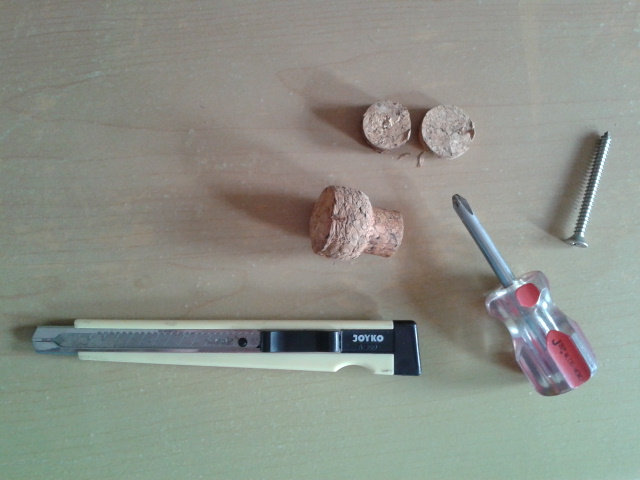
What you need is cutting tool (penknife will do), a screw, screwdriver and a recycled cork!


The old, rusty look of a metal knob sitting on the study desk for years....


TADDDANG......New drawers for your study desk! Just screw that's all.


Like this? For more tips, tune in to ecostarox.blogspot.sg Today! Or simply Like this blog! Have queries, leave a comment!


Friday, July 10, 2009

The way Food can be more Green

Food and Agricultural systems account for up to 30% of every human induced global warming. Here's tips to ameliorate it!

1. Do your homework: food and drink choices to be more environmentally friendly and of course healthy! And most importantly, know what food you need to buy by listing down on a paper to prevent buying unnecessities even if it's "buy-one-get-one free". This can help to prevent overloading of your fridge and (3).

2. Eat local: You can check out how your food is produced and see how much effort they are putting in to reduce emissions. It's even smarter to buy directly from the producer! Wastes as a result of loss due to processing, storage and transportation can be reduced! Transportation via air or shipping also contribute to greenhouse gas emission accounting for 2% and 5% respectively.

3. Eat Fresh: Produce fresh and ripe contain more nutrients as compared to produce which is stored in your fridge for weeks. Storage can deteriorate quality of foods too.

4. Organic foods: depending on the way it's grown, it may be more nutritious (vitamins, minerals e.g. zinc and iron), contain pheolics (thought to help prevent diseases), lesser CO2 emission of about 26% reduction (no use of synthetic nitrogen fertilisers.

5. Water is precious: world uses 200 million litres water per second to grow its food. In fact, agriculture uses 70% world's water and wastes 60% of water every year! Read the WWF's report on 'Thirsty Crops' @ www.wwf.org.uk

6. Biodynamic agriculture: a sustainable way as it is self sufficient--in compost, manures and animal feeds. a higher biodiversity than convention and organic farmed soil.

7. Online Shopping: able to track your buys and how much you buy. It saves on the emission by cars or transportation to shop for foods, though walking is also reasonably great as it exercises your body.

8. Reduce the plastic bags: 400-1000yrs to break down a bag, and what about paper bags? 4 to 6 times energy to produce them. That's why use REUSABLE fairtrade or organic cotton bag. (wash it if it's dirty), and even baskets, trolley, etc.

9. Go Unpackaged!: Stores in UK-Unpackaged-has been selling hundreds of loose products! Herbs, spices, eggs, biscuits, bread, etc--you can bring your own container then. Remember local wet market also have loose products =D

10. Create a compost: around 30% of household waste could be composted and avoided in the landfill. Around 6 months' time, natural fertilisers, mulch and soil conditioner can be obtained. Tips @ www.recyclenow.com or www.howtocompost.org

Hope you have a have a more vivid mind for selection of foods. Let's stay e-c-o.
Tuesday, February 12, 2008

Celebrate a Green & Priceless Christmas

Christmas is just 3 days down the road! I guess the festive's joy and spirit is HIGH from now. Christmas is always accompanied with the festive's decor, especially obvious in the busy Orchard Road. The streets and roads are laid with tonnes of sparkling lightings and christmas decorations such as a huge decorated christmas tree or even a snowman!

Another thing that I need not say and you would already know is the present! How depressing is to see no Christmas presents coming in when someone visits you, right? Some may feel it's alright but a small gift will be more alright. *LOL* I wondered what are people most concerned about their gifts. Is it the gift itself--the $$, the design, the quality, the colours, the type you like--or is it the general appearance of the gift with good nice wrapping papers? But ultimately I think what matter most is the sincerity of the person. Anything else is just a "touch-up", I think so.

Since sincere is what is most important, I think a gift that is wrapped with some low-cost materials such as good conditioned, but unwanted posters, newspapers or even your glossy magazines can be up to good use. These materials aren't bad--they have their quality too. To me, Glossy magazines and posters are even better alternative than to use wrapping paper since they have good quality too and can be quite appealing too. See, the magazine that I used to wrap the box of gift? It's not too bad afterall, right?


Procedures in wrapping a gift using "priceless" materials and efforts.


I am quite like an environmentalist; I care for the environment and support many eco-friendly acts of our parts. Reduce.Reuse.Recycle. This 3 Rs are the golden Rs which we should always remember. So during Christmas this year, why not spend less on wrapping papers and even help to save the trees, environment and the earth? It's a WIN-WIN situation.

Here, I've some ideas on wrapping a gift. It must start with collecting raw materials like reused boxes (from the biscuits or other items), reused wrapping papers (posters, newspaper or magazines, etc), nice reused plastic/paper bags.


Newspaper, posters and magazines


Clean & Reused Boxes

Reusing plastic bags
These raw materials are all foc. Reusing these materials is a big contribution of saving the earth. It's so simple and beneficial. Try it out yourself and you would find yourself an artistic person! MERRY AND GREEN CHRISTMAS!

If you have any other ideas, do contribute here or in your blog and share your url. (=

Tackling Global Warming

Global warming due to emissions of carbon dioxide and other greenhouse gases have contributed to larger extreme climatic events like rising sea levels. The main culprit: Carbon Dioxide.

Dryer conditions in the cloud forest and lengthening dry periods could drive some into extinction ranging from plants to animals. Many tree types are declining in vitality. The study of 13,700 trees in 18 very isolated plots in Brazil concluded that increased carbon dioxide is the most plausible explanation for the abrupt shifts in species growth. And looking at the big picture, what do you see? Without trees, what could have happened?

Sixteen years of data on tree growth, tropical air temperatures and CO2 readings indicate that a warming climate may cause the tropical forests to give off more carbon dioxide than they take up. This would upset the common belief that tropical forests are always a sink for carbon, taking huge amounts out of the atmosphere.

Coral reefs are probably the most complex ecosystems on the planet, home to hundreds of thousands of species. They protect and support the lives of millions of people around the tropical zones, and are a font of wealth from fishing and recreation. The damage being caused to reefs by warming seas is one of the most serious effects of global warming.

High water temperatures caused coral bleaching and subsequent death or adverse change to sixteen percent of world reefs overall and up to 46 percent in parts of the Indian Ocean.

Temperatures beyond norms causes coral to expel the microscopic symbionts, zooxanthellae, that also give them colour. If this bleaching continues for days to weeks, the coral dies and algae takes over the reefs, changing the ecosystem.


Let's Begin Taking the following tips today:


1. Buy a Fuel Efficient Car. Getting a few extra miles per gallon makes a big difference. Save thousands of lbs. of carbon dioxide and a lot of money per year.

2. Carpool When You CanOwn a big vehicle? Carpooling with friends and co-workers saves fuel. Save 790 lbs. of carbon dioxide and hundreds of dollars per year.

3. Reduce GarbageBuy products with less packaging and recycle paper, plastic and glass. Save 2,000 lbs. of carbon dioxide per year.Composting helps reduce greenhouse gas emissions by reducing the number of trips trucks must make to the landfill as well as the amount of methane released by our landfills. [I recycle papers and plastic bottles, metals, glass bottles as far as possible in the recycling bin. So can you.]

4. Use Recycled Paper. Make sure your printer paper is 100% post consumer recycled paper. Save 5 lbs. of carbon dioxide per ream of paper.

5. Unplug Un-used Electronics. Even when electronic devices are turned off, they use energy. Save over 1,000 lbs of carbon dioxide and $150 per year.

6. Plant a Tree. Trees provide a microclimate and sustained moisture for you. Trees suck up carbon dioxide and make clean air for us to breath. Save 2,000 lbs. of carbon dioxide per year.


Reference: http://www.worldviewofglobalwarming.org/pages/tropics-oceans.html
http://www.globalwarming.net/